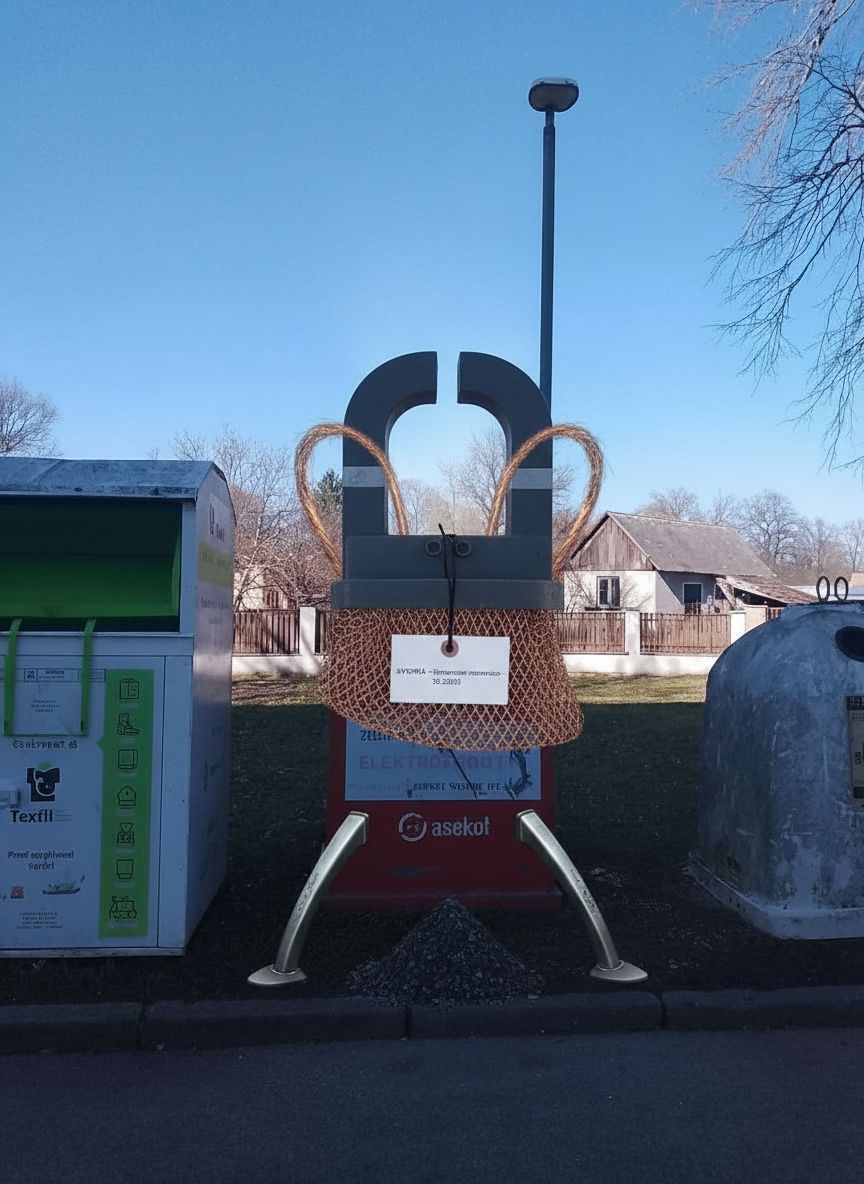
“Svorka”
Elektrožrout (strážnický)
Electrourna moravica
Common name: Elektrožrout (strážnický) Scientific classification: Technovita/Ferranimia/Conductorata/Laminotheria/Urbanomorpha/Urnicolidae/Electrourna/moravica Rarity: Uncommon (localized, seasonally detectable). Updated description (post-capture): The Elektrožrout is an infrastructure-symbiont that masquerades as, or inhabits, municipal e-waste containers—most often the red “ELEKTRO” type—along quiet residential edges like Na Kamenčí. At rest it is indistinguishable from the bin: the “lid” is a hinged carapace of painted, enamel-like keratin impregnated with iron oxide, and the white label panel is actually a pale, scar-smooth ventral membrane that can flush pink when it is metabolizing. When active, the container subtly “unfolds” into a squat quadruped roughly 1.1–1.3 m long and 0.9 m tall: the corners extrude into jointed legs resembling folded sheet-metal brackets, ending in rubbery pads that leave no prints on asphalt. Two oval “handles” become sensory auricles lined with fine copper filaments; these detect electromagnetic leakage from batteries and chargers. Its mouth is a slot beneath the lid seam, ringed with graphite-black denticles that rasp insulation off wires. Diet is not metal itself but the polymer binders, electrolytes, and trace organics in batteries and capacitors; it excretes a dry, sand-like slag of inert silicates and manganese oxides that gathers under bins like gritty pepper. New traits observed during capture: (1) The auricular copper filaments can actively “stand up” (piloerection-like) when the animal is feeding, likely increasing antenna surface area; under strong magnetic bias they collapse and remain limp, suggesting magnetosensory overload rather than mere discomfort. (2) The ventral label-membrane blush is rapid (seconds) and appears to pulse once just before torpor, consistent with a final dump of charge from the laminar bioelectric organ. Behavior: It is most active on clear, breezy Saturdays around midday (a local joke calls it “polední sběrač” because it stirs when people do errands). It shuffles only a few meters, repositioning itself to intercept fresh drops of electronics, then goes rigid again. If startled, it “plays municipal”: it locks its joints, aligns to the curb, and vents a faint warm-air sigh that smells like ozone and old plastic. In magnet-induced torpor, it performs an exaggerated version of this—fully retracting limbs and maintaining alignment for hours to days, with minimal venting. Strengths/weaknesses: Its camouflage is nearly perfect and it can tolerate cold down to −10 °C by using exothermic redox reactions in a specialized “anode stomach.” However, it is vulnerable to heavy rain (water shorts its sensory filaments) and to strong magnets, which disorient its copper-lined auricles and can force it into a torpid, bin-like state for days. The successful clamp capture confirms that sustained, properly oriented magnetic fields can suppress the ‘missing minutes’ EMI effect by collapsing auricular filament activity and interrupting charge cycling. Unexplained phenomenon (scientific note): Witnesses report brief “missing minutes” when standing close—consistent with the creature generating a localized, low-intensity electromagnetic interference field while digesting lithium cells. A plausible mechanism is a bioelectric organ layered through its laminar musculature that induces eddy currents in nearby conductors; this can disrupt phone clocks and create a subjective time-slip via mild vestibular stimulation, not true temporal distortion. During capture, the Faraday skirt around the magnet clamp appeared to attenuate this field enough that observers reported no time-slip. Ecological niche/backstory: It likely arose from a myrmecophilous (ant-associated) lineage that transitioned to urban heat islands and learned to exploit human-made energy-dense waste. In Strážnice, it is tolerated because it quietly reduces hazardous battery leakage—though it occasionally “tidies” working devices left too close, an act locals blame on a mischievous skřítek with a recycling obsession. Individual (captured): “Svorka” (nickname assigned after its clamp-induced torpor). Currently immobilized in a bin-mimic posture with limbs retracted; auricular loops are held within a Halbach magnet clamp and copper mesh skirt, and it shows reduced venting and no detectable ‘missing minutes’ effect while clamped. No external injury noted beyond minor denticle wear from the sacrificial polymer bait.
Discovery Details
🎮 Play CryptoCam Early Access!
CryptoCam is now available in Early Access on Google Play. Jump in and start your cryptid research adventure!
🔍 What is Early Access?
Early Access means you're playing CryptoCam while we're still actively developing it. Expect new features, improvements, and occasional bugs. Your feedback directly shapes the game's future!