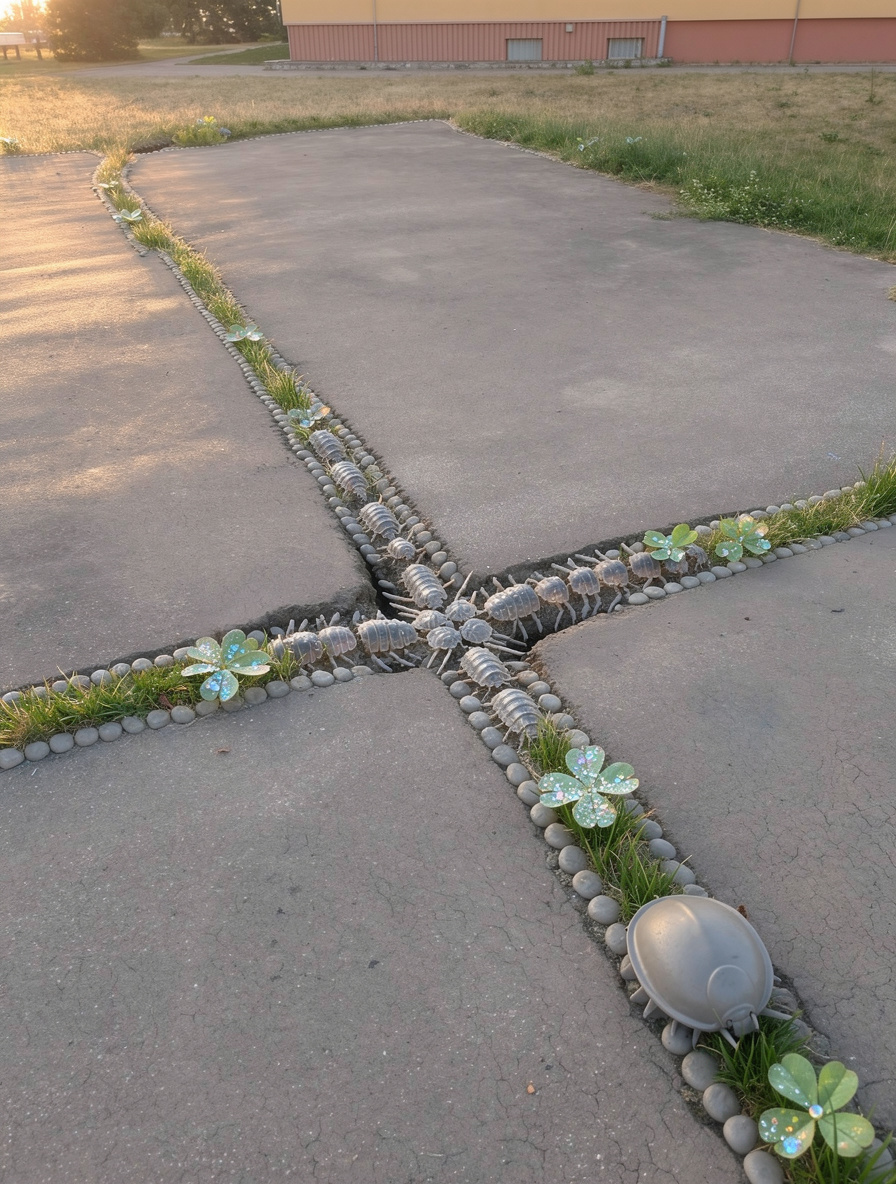
“Křižovatka”
Spárožil
Herbavena herbavena cruciformis
Rarity: Uncommon. Herbavena cruciformis is a colonial organism resembling a living network of grass-filled cracks in pavement, but which is in fact a single, flattened arthropod that has evolved to inhabit the expansion joints and fractures of abandoned concrete surfaces across Central Europe. The creature's body is segmented into long, ribbon-like branches averaging 5–15 cm wide and extending up to 20 meters in total length, forming cross-shaped or radial patterns. Its dorsal surface is covered in a dense mat of symbiotic grasses and clovers cultivated in a thin layer of self-produced humus secreted from specialized glands along its back. This living camouflage renders it virtually invisible against the pavement it inhabits. The ventral surface is a pale grey chitin that mimics cracked concrete, and hundreds of tiny, translucent legs—each no longer than 3 mm—grip the interior walls of the cracks with remarkable adhesion. The Spárožil feeds by extending fine root-like chemosensory filaments into the soil beneath the concrete, absorbing dissolved minerals and microorganisms. It supplements this diet by trapping insects that land on its clover flowers, which secrete a mildly adhesive nectar. The symbiotic grasses on its back photosynthesize and share sugars with the host through mycorrhizal intermediaries embedded in the dorsal chitin—a form of tripartite mutualism unprecedented in known biology. The creature is most active during warm summer evenings, when it slowly migrates along crack networks at roughly 2 cm per hour, expanding its territory. It reproduces by fragmentation: when a concrete slab shifts or breaks, separated segments regenerate into new individuals. Its primary weakness is fresh asphalt resurfacing, which entombs it. Locals in the Hodonín district have long noticed that certain abandoned lots seem to "heal" their cracks with suspiciously uniform grass, and older residents of Strážnice whisper that the green lines move between seasons—never quite where you remember them. The species likely diverged from subterranean isopod ancestors during the 20th century's rapid concrete expansion across Moravian farmland, exploiting a novel ecological niche with breathtaking evolutionary speed.
Discovery Details
🎮 Play CryptoCam Early Access!
CryptoCam is now available in Early Access on Google Play. Jump in and start your cryptid research adventure!
🔍 What is Early Access?
Early Access means you're playing CryptoCam while we're still actively developing it. Expect new features, improvements, and occasional bugs. Your feedback directly shapes the game's future!