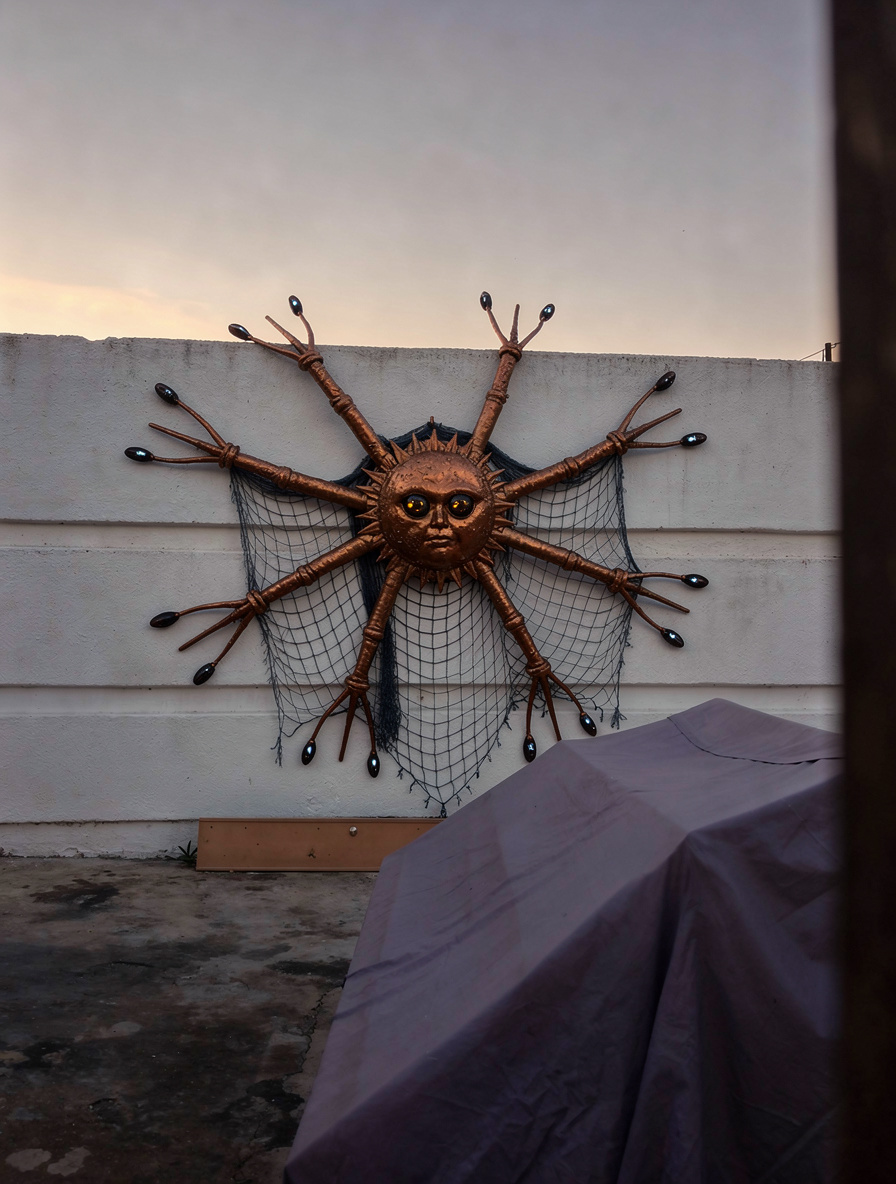
“Řežábek”
Síťový sluneční pavouk
Helioreticulum h. moravicum
Rarity: Uncommon. Helioreticulum moravicum is a remarkable arachnid-adjacent cryptid endemic to the warm, wine-growing lowlands of South Moravia, Czech Republic. Adults reach a leg span of approximately 60–80 cm, with a flattened, radially symmetrical body disc measuring 15–20 cm in diameter. The central carapace is composed of oxidized chitin plates arranged in a sunburst pattern, giving it the unmistakable appearance of a decorative metal sun face — complete with raised ridges mimicking rays and two dark ocelli positioned to resemble stylized eyes. This extraordinary crypsis is not coincidental; the species has co-evolved alongside human architectural ornamentation over centuries, exploiting the Moravian tradition of decorating courtyard walls with metalwork and fishing nets. The creature's eight primary limbs are extraordinarily thin and darkened, resembling knotted netting cord. When at rest, the Síťový sluneční pavouk splays its legs outward and secretes a silk-like adhesive webbing between them that dries into a mesh virtually indistinguishable from decorative fishing net. It anchors itself to white-washed walls at dusk, positioning its sun-disc body centrally and extending its net-limbs in elegant draping swags. It feeds on moths, beetles, and small geckos attracted to the warm walls during summer evenings. The creature's copper-toned carapace is mildly thermogenic — it absorbs solar radiation during the day and radiates gentle warmth (up to 38°C surface temperature) well into the night, functioning as a lure for thermophilic insects. This bio-thermic capacity is achieved through a dense network of hemolymph capillaries beneath the chitin plates containing high concentrations of copper-based hemocyanin, which gives the exoskeleton its distinctive bronze-red metallic sheen. The species is strictly crepuscular and nocturnal; during daylight it remains motionless, indistinguishable from wall décor. Its primary weakness is rain — prolonged moisture dissolves the adhesive silk of its net-limbs, forcing it to relocate. Specimens have been documented on courtyard walls across Strážnice, Hodonín, and Břeclav, always on south-facing surfaces. Locals who notice their "sun decorations" shifting position between mornings have long attributed this to wind or pranksters, never suspecting the ornament itself is alive.
Discovery Details
🎮 Play CryptoCam Early Access!
CryptoCam is now available in Early Access on Google Play. Jump in and start your cryptid research adventure!
🔍 What is Early Access?
Early Access means you're playing CryptoCam while we're still actively developing it. Expect new features, improvements, and occasional bugs. Your feedback directly shapes the game's future!